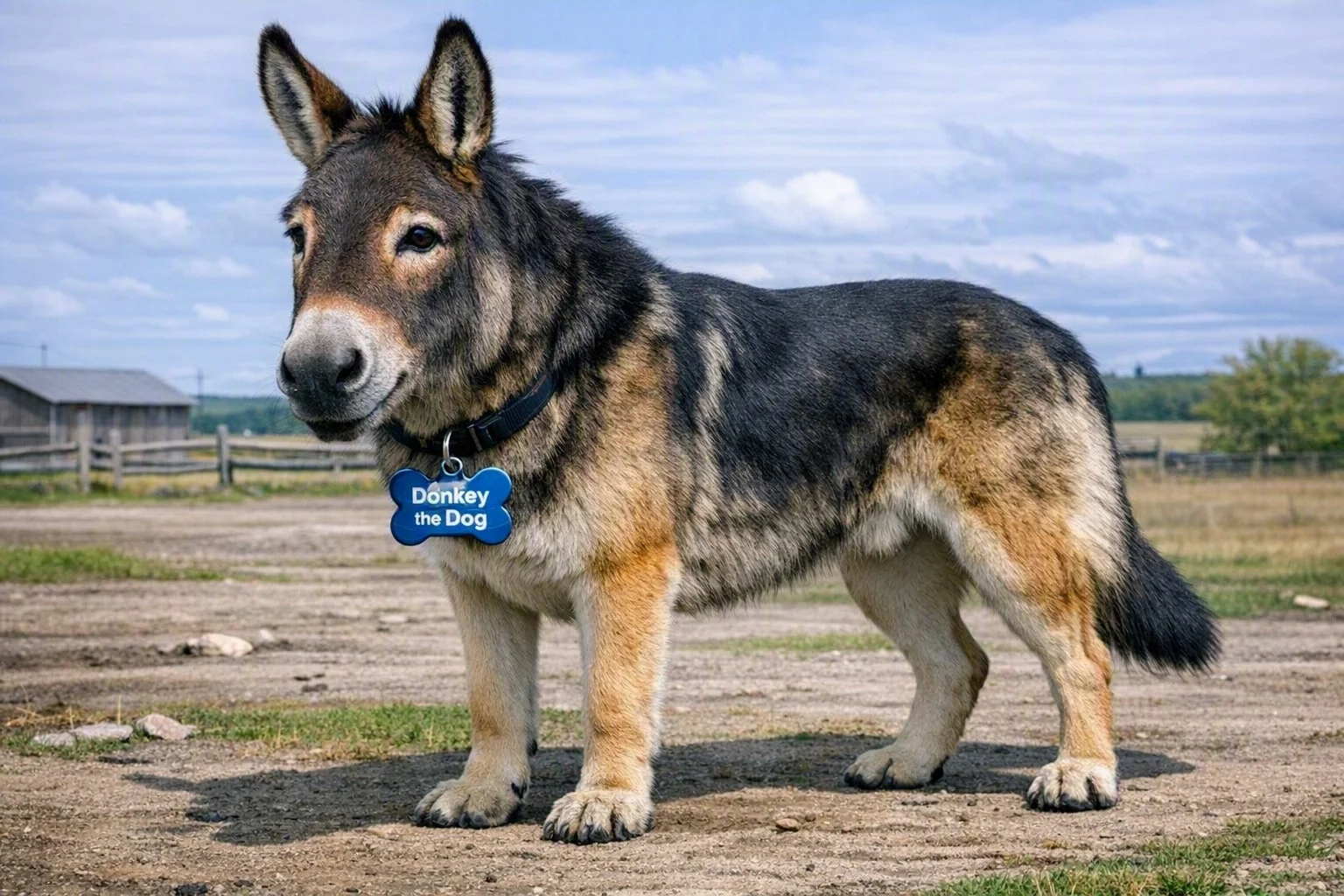
When a rescue dog named Donkey bites
Hello Terry,
Here is a summary of our Skype time together for Donkey.
General Overview of Donkey
Donkey has the behavioral traits common to dogs from rural areas adopted as shelter dogs/strays. Fear/avoidance of men, defensive behavior toward strange dogs, initially unaccustomed to crowded sidewalks, normal house sounds, etc. His nighttime activities and months of adjustment tell me Donkey did not have a history as a house dog. House dogs acclimate to the circadian rhythms of humans, which are the opposite of canines.
Stress-disordered dogs exhibit the tics you mentioned, disrupted circadian rhythms, and odd eating behaviors.
These dogs see the world as a threat and with justification. Dogs that suffer from neglect, active abuse and trauma as pups experience brain changes. Because the dog is now an adult and living in a stable, kind and loving home did not mean his brain changed along with the address.
Donkey anticipates harm when in the presence of strange dogs and strange men. These responses will not change and can be managed. He shows a preference for avoidance and a safe haven in the presence of strange men. Providing he can access his safe haven or find space to distance himself, and men do not intrude in his space (as he defines space) he poses no threat.
Dogs with Donkey's background are hyper sensitive to human's body and facial cues. They observe tiny movements the human may be unaware they are making. His interpretations of these cues are sent through a trauma brain therefore making his responses avoidant/fear/defensive. His responses to the cues depend on who makes them and in what context.
Hyper sensitive to cues dogs do not do well with loud, boisterous people making big, overt gestures. Donkey cannot be around those people without his trauma brain perceiving such people as a threat. If people cannot change for Donkey they should not be around him.
When Donkey views a person or situation as ambiguous his default is 'this is a threat' and his defense from threats is active avoidance. As long as there is an escape route, physical and/or mental, he avoids confrontation.
Donkey has had good relationships with children. He has had good relationships with women. He consistently avoids men he does not know, like or feel at ease with. He has had good relationships with some children.
Overview of bite event
Some general principles of dog bite analysis in general and Donkey in particular.
What a dog did with his mouth he intended to do.
When a dog snaps at a human and closes his teeth a quarter inch from the human that was the dog's intent. When a dog grips and shakes a human that was his intent. Adult dogs do not make mistakes with their mouths.
The bite to Warren's lip was a bite and release. He intended to use a small amount of effort and inflict a small amount of damage.
2. How much effort did the dog make?
Dogs who make no effort or a small effort are a different category than a dog who makes a big effort to bite. Dog who lunge, from the floor upward, to bite a face, charge across a floor, chase a human through the house are examples of big effort bites.
The bite to Warren's lip was a small effort bite. He bit the nearest and easiest target.
3. Was the dog awake when the bite happened?
Sleeping, dozing or drugged dogs lose bite inhibition. A common scenario with pet dogs is when a dozing dog bites the owner who bends down to kiss or pet the dog. Bite inhibition is absent/lessened in a sleeping dog.
The bite to Warren's lip was from a drowsing dog. Also, the movement when Warren pushed away from him was a force multiplier; that of a startled, drowsy dog.
The other incident when he roared at a child was similar. Drowsy dog approached too quickly by a strange child.
Donkey did not exhibit loss of control at the lip bite to Warren despite being startled from drowsiness. Rather, he exhibited good control. He used a small amount of energy, released after the bite, did not bite again, restrained himself and did not pursue Warren. Pursuit was possible and Donkey did not pursue Warren.
A loss of control be lunging out, repeated and deep bites and no restraint from the dog. He restrained himself and was not stopped by a human.
The roaring/ferocious bark at the child demonstrated control. He used minimal energy, sound and display of teeth but did not use teeth. A display is a minimal effort designed to get the opponent to do what the displaying animal wants.
The event with the cat is not an indicator that Donkey is getting more aggressive, more difficult to handle, etc. He is not accustomed to the cat pestering him at his food bowl. Again, he used minimal energy of roaring and display of teeth but did not use teeth. This problem is easily managed with different feeding routines.
4. Would a normal (non-rescue) dog have done the same behavior(s)?
Clear thinking about dog bites, unclouded by emotional residue, is mandatory. If emotional reasoning alone is used faulty conclusions are made. Because a dog is a rescue does not mean we use different logic. A non-rescue dog would have done the same responses to the same activators. Donkey did not do anything out of the ordinary for dogs. He does have bad background 'stuff' but none of that was at play with the lip bite to Warren, the cat incident or the roaring at the child.
5. Change(s) in posture from the human
All dogs change when the human gets on the floor. Regardless of the breed or age dogs become energized when the usually standing up human assumes a sitting or lieing down position. Despite the popularity of Facebook posts of children using dogs as pillows, adults cuddling closely with adult dogs this is not a good idea. Dogs with a high startle response (Donkey) are put in danger of losing bite inhibition when sudden, unexpected movements come from the human.
Recommendations for Donkey
Be impeccable in your consistency.
No kissy face. Kissing, nuzzling a dog's face is always a bad idea. A really bad idea.
No hugging. Dogs hate hugging and at most tolerate it. Hugging blocks a dog's escape route. Many a facial bite happens when dogs are hugged. Humans see it as affection. Dogs see it as a trap. Dogs are right.
Children are either well- mannered and gentle or Donkey is absent from the situation.
Let sleeping/dozing dogs lie. Let them alone. Do not touch them.
Strange dogs are threats and always will be. Dog parks are a bad idea. (Dog parks are a bad idea for any dog…
If you enjoy training as a hobby, continue. Training has no effect on changing Donkey. Any form of 'dominance training' where Donkey is physically forced, restrained physically to force submission, or shouted at to force submission backfires. This training has been popularized by slick television trainers and has no place in Donkey's life. (Or any other dog's.)
Alcohol and other drugs used by humans and dogs are a bad combination. Drugs lessen human inhibition, affect judgement and alter the body's chemical make-up thus making the scent of the human different. I
Donkey has made the transition to his new life. This is who he is. Proper management and impeccable consistency are the critical factors not training.
Donkey is no more and no less dangerous now than he was before the lip bite to Warren. He is exactly the same dog. He poses no less or more of a threat than before the lip bite.
Thank you for making me a part of your lives. It was a pleasure
Dr. Sue Myles